Artificial Creativity
We are heading into a world where an effectively infinite amount of digital content can be generated on demand. The obvious fear is that this flood of synthetic media devalues everything human artists make. Ilja Mirsky’s answer runs in the opposite direction.
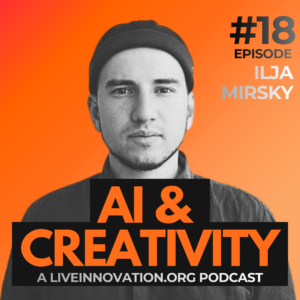
Mirsky is a digital dramaturg, a lecturer at the Academy of Performing Arts Baden-Württemberg, and a PhD candidate at the University of Tübingen in collaboration with Zurich University of the Arts. He works at the point where cognitive science, software code, and live theatre meet, one of the few people bringing genuine technical understanding and critical theatrical framing to the same table. In our recent conversation on the AI & Creativity podcast in the LiveInnovation YouTube channel, he made a case I keep returning to: the more content AI generates, the more valuable a real body in a real room becomes.
Here is the argument, and what it means for anyone building at the intersection of AI and creativity.
What Is Digital Dramaturgy?
Digital dramaturgy is the practice of treating software — programming languages, algorithms, and hardware code — as a foundational text layer of a theatrical production, on equal footing with the written script.
In classical dramatic theatre, the written text is the groundwork on which a staging is built. Mirsky’s concept expands that idea. The code executed by machines and the text performed by actors become two intertwined layers of the same work. His PhD dissertation is an attempt to build a theoretical framework for exactly this shift — how dramaturgical practice changes once code is treated as a creative element rather than a technical afterthought.
He frames it historically. The Renaissance introduced scenography and perspective painting to the stage, and that technical revolution is part of what allowed playwrights like Shakespeare to flourish. Digital dramaturgy, in his view, is the equivalent shift for our era: a new technical layer that will reshape what performance can be.
Why AI Belongs in the Rehearsal Room, Not on Stage
The most useful reframing in the whole conversation is this: the value of AI in theatre lies in how work gets made, not in what the audience sees on opening night.
Mirsky points out that the rehearsal process has barely changed in over fifty years. Actors stand in an analog room, holding physical scripts, gesturing around mock sets. His flagship project, KASPAR 2028, targets that stagnation directly. Built with film director and AI researcher Manu Henry and Professor Lena Gieseke, the project uses a custom AI system nicknamed “Kai” that clones an actor and acts as an interactive digital mirror during rehearsals. It mirrors, extends, and responds to an actor’s speech and movement in real time, creating a kind of virtual co-presence inside an Unreal Engine production setup. The material generated through that pipeline is being used to restage Peter Handke’s 1968 play Kaspar.
The contrast with stage-facing AI is deliberate. When AI is used purely as a visual display in front of an audience, it produces a superficial “wow effect” that quickly curdles into disappointment. As Mirsky puts it:
“We are going to concerts or to theatre to performances because of the actors and because of this whole environment, and not because we want to see some projections on the stage or robots performing on the stage.”
The lesson generalises well beyond theatre: the highest-leverage place to put AI is often upstream, in the creative process, where it changes what humans can explore — not downstream, as a spectacle bolted onto the final product.
The Abundance Paradox: Why AI Makes Live Theatre More Valuable
This is the argument that sits closest to my own research, and Mirsky builds it cleanly.
Every major technological disruption that created sudden material abundance — the printing press, steam power — ended up reminding people what humans are uniquely suited for. His sharpest example is photography. When the camera arrived, people did not stop painting. Painting simply took on a different set of aesthetic values; it moved toward what photography could not do.
Apply the same logic to synthetic media. As AI produces an endless flood of generated content, the things it cannot replicate — physical presence, real-time human gathering, embodied performance — become scarce, and scarcity elevates value. Concerts, theatre, and live performing arts don’t lose ground in an age of abundance. They gain it.
“We as human artists can somehow make use of the technology and kind of be above the technology — not let us being dominated by the technology, but on the opposite, just use it as a tool.”
For creators anxious about being drowned out, this is the reframe worth internalising: abundance of the synthetic raises the premium on the authentic.
Don’t Confuse a Bad Experience With a Bad Medium
One of Mirsky’s most practically useful points is about how audiences and critics misjudge new technology.
Someone tries VR once, gets motion sick, and concludes “VR isn’t for me.” But the same person might see one bad play and decide “I don’t like theatre” — a conclusion they’d recognise as absurd. In both cases, the mistake is identical: mistaking poor content or weak execution for a failure of the medium itself.
The implication for anyone working with emerging tech is to separate the two variables before passing judgment. A disorienting first VR experience says nothing about VR’s ceiling as an artistic medium. It says the content was badly made. Treating those as the same thing kills promising tools before they’ve had a fair test.
The Risks Mirsky Refuses to Ignore
This is not techno-optimism. Mirsky is openly critical of the hype cycle.
He argues the industry is fixated on Large Language Models while ignoring the artistic potential of small, specialised generative models better suited to specific creative needs. He’s blunt that AI text generation and translation frequently produce worse quality than human work, and that using AI simply because it is faster tends to sacrifice the craft.
He is also clear-eyed about labour. Voice actors, film actors, and audio performers face serious economic threats from AI cloning. Live theatre, he suggests, is one of the last strongholds resisting full automated replacement:
“Theatre is maybe like the last enemy when it comes to AI, and therefore I think it’s quite important to have those discussions in theatre.”
That framing — theatre as the last enemy — is exactly why the conversation matters beyond the stage. Wherever AI meets human craft, the questions are the same.
What This Means for Creators
Several concrete principles come out of the conversation for anyone integrating AI into creative work:
Extend the try-out phase. Mirsky argues complex tech integrations fail when squeezed into a standard few-week rehearsal cycle. Give them months or years of iterative testing with real audiences before any high-stakes premiere.
Appoint a critical outside eye. Every tech-driven project needs someone whose explicit job is to challenge the technology and strip it out when it isn’t serving the work. His own instinct is telling:
“If there is like the chance to get rid of it, just get rid of it.”
Lower the barrier to entry. In an early interactive installation, his team found that simply translating the interface into users’ native language let people focus on the story instead of fighting the tool. Reduce friction before adding features.
Look past the big models. The most interesting creative applications may live in small, specialised models tailored to a specific artistic purpose, not in the largest commercial system available.
Watch the Full Conversation
Mirsky’s perspective is a useful antidote to both AI hype and AI panic. Technology has always forced art forms to evolve rather than replace them — theatre was among the very first institutions in Europe to adopt electric lighting, partly to stop its own buildings burning down from gas lamps. Digital dramaturgy is the next chapter of that long relationship.
The full interview goes deeper into KASPAR 2028, the history of technology on stage, and what genuine human creativity actually is.
Watch it on the LiveInnovation YouTube channel.