Artificial Creativity
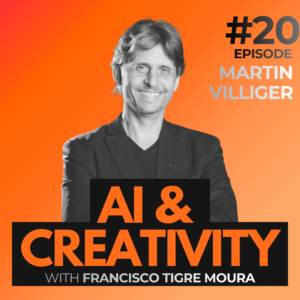
This conversation is part of the AI & Creativity podcast series, where I talk with the researchers, artists, and founders shaping how machines and human creativity meet. In this episode I spoke with Martin Villiger, one of Switzerland’s most prolific film composers, with credits on more than 130 films, over 400 series episodes, and campaigns for brands like Apple, Samsung, and Netflix. Classically trained and a pioneer in immersive audio, he founded Visual Music in 2000, mentors composition students at the Zurich University of the Arts, and is known for live “Emotional Composing” performances where he improvises music in real time from emotions the audience shouts out, a talent that’s earned him the nickname “the Swiss Hans Zimmer.” He’s also become one of the most clear-eyed voices on what AI actually means for working musicians. And one experiment in particular crystallised his whole position.
The Experiment That Made the Argument
Villiger scored an entire short film using Suno, the generative AI music tool. The result was technically finished. And he felt nothing.
He refused to register it as his own composition — not out of principle-signalling, but because of a genuine absence:
“I prompted an idea. The idea is mine, but it’s not my music and I don’t feel I’ve composed it, and I’m not going to register it because it’s AI.”
That reaction is the entry point to the most useful concept in the conversation — one that happens to come straight from consumer psychology.
What Is Psychological Ownership — and Why AI Music Lacks It
Psychological ownership is the sense of emotional attachment, identity, and pride we feel toward something we’ve created — the feeling that a work is genuinely “mine.” It’s what turns a finished artefact into a personal one.
Villiger’s Suno experiment produced zero psychological ownership. His explanation is precise: prompting a model feels like delegating the job to a second composer or an assistant, not like composing. Because he never physically laboured over the music — never made the small, effortful decisions that accumulate into a piece — no emotional connection formed. The output existed, but it wasn’t his in any way that mattered to him.
This is the part of the AI-and-art debate that pure product evaluation keeps missing. You can generate a plausible track in minutes, but the value an artist derives from creation was never only in the finished file. It was in the doing. And for Villiger, that doing isn’t optional — it’s a compulsion:
“There must be another reason for us to still do it. So one reason for me is: I have to do it. This is like the artist’s curse — I just can’t not do it.”
Why AI Pushes Humans Toward Wilder Ideas
One of Villiger’s sharpest observations is about where generative AI naturally lands. Because these models are built on statistical averages, they gravitate toward the middle — the safe, the standard, the broadly pleasing.
“AI is always trying to go to the middle: please everyone, maybe please no one through that. And we humans sometimes have some wild ideas.”
That has a liberating implication for human composers. If the machine reliably produces competent middle-of-the-road music, the human’s job is to go somewhere the average can’t reach. Villiger’s example is scoring an entire film using nothing but recordings of rocks. Survival, in his framing, means embracing wild, slightly unhinged, deeply specific ideas that a statistical model would never converge on. The flood of generic AI output doesn’t kill experimentation — it raises the premium on it.
The Myth of Effortless AI
The marketing promise around generative tools is effortlessness: describe what you want, receive a finished result. Villiger’s experience directly contradicts this.
Getting a usable score out of Suno took continuous rewrites, prompt adjustments, and workarounds. Wrestling the model into thematic consistency took him longer than simply composing the piece from scratch would have. The effort didn’t disappear — it just moved. He points out that film directors who lean on AI to save on composer fees often end up spending dozens of their own hours tweaking prompts and edits, quietly converting a composer’s fee into their own lost time.
His verdict is blunt:
“There is no such thing as no effort. People who say there’s no effort — yeah, then you have AI slop.”
The choice isn’t between effort and no effort. It’s between effort that builds ownership and effort that produces something nobody feels connected to.
AI Can Analyse Music, but It Can’t Feel It
Villiger once asked an AI system whether it could actually hear music. The system was honest: it can analyse volume, frequencies, and arrays of data, but it cannot experience sound.
That distinction matters more in music than almost anywhere else, because music triggers fast emotional reactions in humans before conscious thought catches up. A model with no body and no capacity to feel can mimic how a human might react to a passage, but it never has the sensation itself. It reproduces the pattern of emotion without the emotion.
How Villiger Actually Uses AI
None of this makes Villiger anti-AI. He draws a firm line between two categories.
Generative AI — producing complete tracks from a text prompt — he rejects, because it removes the joy of composing and the ownership that comes with it. Functional AI he embraces enthusiastically: tools that absorb the tedious, non-creative drag of the job. De-essing, detecting mistakes across tracks, cutting 30-second commercial edits, formatting uploads, drafting client proposals. The principle is clean: let AI take the administrative load so you reclaim time for the actual composing.
His advice to other composers follows from this: master the tools yourself. “You should be the expert of AI, not your client coming to you.” When a client insists “AI can do this in two minutes,” a composer who has actually used Suno can explain the hidden costs, the lack of iteration control, and the legal grey areas from direct experience — rather than sounding defensive.
Will AI Replace Human Composers?
Villiger’s answer is no, and his reasoning is grounded rather than sentimental. In high-stakes work like advertising, where a few seconds of music can make or break a multi-million-euro campaign, agencies still want human composers who understand subtle emotional nuance. And underneath the commercial logic sits something more fundamental:
“We humans always crave connection. We are not pleased only with artificial connection, and music is the strongest connector.”
The strategic move for human artists, then, is to climb the value chain rather than compete on speed. Focus on overarching concepts, live performance, and genuine human relationships — the things a prompt can’t touch. His spontaneous piano concerts, where he builds complete pieces live from a word an audience member calls out, are the whole thesis compressed into a single performance: presence, risk, and connection that no generated file can reproduce.
What This Means for Composers and Creators
Three practical takeaways:
Master the tool so you can push back. Test generative AI personally, so you can speak from experience about its real costs instead of fearing or overselling it.
Move upward. Compete on concept, performance, and relationships, not on generating generic tracks faster.
Delegate the drag, not the craft. Use AI for formatting, error-detection, editing, and outreach — and keep the composing, and the ownership it creates, for yourself.
Watch the Full Conversation
Villiger is proof that you can be deeply fluent in these tools and still refuse to hand them the part of the work that makes it yours. The lesson generalises well beyond music: in an age of infinite average output, the human edge is the wild idea, the effort that builds ownership, and the connection only a person can offer.
The full interview goes deeper into the Suno experiment, his live concerts, and why he thinks art students are right to be sceptical of AI hype. Watch it on the LiveInnovation YouTube channel.