Artificial Creativity
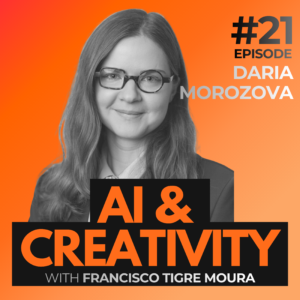
This conversation is part of the AI & Creativity podcast series, where I talk with the researchers, artists, and founders shaping how machines and human creativity meet. In this episode I spoke with Daria Morozova, an assistant professor at Leiden University with a PhD in Management from HEC Paris, who researches psychological ownership and human-AI co-creation in the workplace. She’s also an unusually multidisciplinary creator in her own right: a trained visual artist who has exhibited in Russia, Germany, and France, a poet, a stand-up comedian, and currently a novelist. That combination matters here, because her central warning about AI isn’t about the technology at all. It’s about us and it reframes the relationship between AI and critical thinking in a way every student, educator, and creative professional should sit with.
The Real Risk Isn’t AI. It’s Self-Surrender
Most anxiety about AI and creativity assumes the threat comes from the machine getting too good. Morozova’s research points somewhere more uncomfortable: the threat is how quickly people abandon their own creative potential before they’ve even tried.
“What I’m quite concerned about is that people are really willing to give up on thinking that they’re creative… willing to just be very quick to surrender to AI.”
The mechanism is low self-efficacy. Students and professionals who don’t trust their own ideas offload the work to a model the moment a task feels hard — skipping precisely the uncomfortable early stage where real creative problem-solving happens. And in bypassing that struggle, they lose the thing that struggle produces: not just a better output, but the personal growth and fulfilment of having wrestled something into being yourself. The technology doesn’t take your creativity. You hand it over.
What Actually Determines Creative Ownership: The Seed
Here’s where Morozova’s work gets genuinely surprising, and where it complicates the intuition from my earlier conversation with composer Martin Villiger, who felt no ownership over an AI-assisted score because he hadn’t physically laboured over it.
Across interviews with marketing managers and lawyers, followed by controlled experiments, Morozova found that psychological ownership is not determined by how much AI did the work. Someone can lean heavily on a model and still feel full pride and ownership — or use it lightly and feel none. The deciding factor is where the initial idea came from.
“What actually matters is not how much they’re using it… but where the idea is coming from. What matters essentially is that the seed of creativity fed to the tool is your own.”
Call it the creative seed principle. As long as the core concept, structure, or spark originated with the human, people feel genuine pride when the result is praised, even if AI executed most of the downstream labour. It’s a liberating finding for anyone worried that using AI “cheapens” their work. It doesn’t, provided the origin is authentically theirs. The danger isn’t delegation. It’s delegating the seed.
Does Using AI Make You Less Creative?
Not inherently — but the way most people use large language models quietly erodes the critical thinking that creativity depends on. This is the sharpest point in the conversation, and it’s where AI and critical thinking collide most directly.
When students use an LLM to answer a complex or abstract question, Morozova observes, they tend to accept the polished output at face value. They never engage with the internal logic, the purpose, or the trade-offs behind the conclusion. The result is an illusion of learning: the answer looks finished, so it feels understood.
“Students are losing out a little bit on understanding how the sausage is made.”
Without grasping how the sausage is made, people lose the ability to build internally consistent, purposeful frameworks of their own — the very capacity that lets someone generate original ideas rather than assemble borrowed ones. For educators, her implication is pointed: stop accepting polished AI-assisted answers, and require people to defend the step-by-step reasoning and intent behind them. Critical thinking isn’t tested by the output. It’s tested by whether you can account for it.
Using AI as a Test for Banality
One of Morozova’s most practical techniques flips the usual use of AI on its head. While writing her novel The Cufflink, she used LLMs not to generate text she would keep, but to generate text she would deliberately avoid.
Ask a model to write a standard interaction between two characters, and it will hand you the statistical average — the most expected, generic version of that scene. Morozova treats that output as a baseline of banality.
“In a way, AI was here more of a test for banality… once you understand that what you write in the novel is quite different from what would be expected, it was quite helpful.”
The AI shows her the cliché so she can write its opposite. The model becomes a map of everything predictable, freeing the human to go everywhere it isn’t. It’s the same insight several guests on this series keep arriving at from different directions: because generative AI gravitates toward the middle, its greatest gift to a human creator may be showing you exactly which middle to escape.
Your Creativity Has a Terroir
Underneath all of this sits a question about what makes human creativity distinct at all. Morozova’s answer draws on the idea of situated humanness — that creativity is inseparable from the specific body and history of the person making it. Her metaphor is wine.
“It’s sort of like wine — you have the region of specific wines. In that matter, our creativity is specific to each one of us… in our physicalities and experiences.”
A model trained on the aggregate of human output has no terroir. It has no particular body, no particular past, no single vantage point from which the world looks a certain way. Your creativity is specific to you precisely because it’s grown from a life only you have lived. That’s not something a prompt can reproduce — but it is something you can abandon by never developing it.
What This Means for Creators and Educators
Three takeaways worth acting on:
Protect the seed. Before you open a model, formulate the core idea, thesis, or structure yourself. That single habit preserves both the quality of the work and your psychological ownership of it.
Use AI as a sounding board, not an author. Simulate dialogue, stress-test your logic, map the clichés to avoid — without copying generated sentences into the final work.
Teach consistency over speed. If you educate or manage, require people to defend the reasoning behind AI-assisted answers rather than rewarding polished text. Understanding how the sausage is made is the skill; the sausage is not.
Watch the Full Conversation
Morozova’s perspective is bracing because it moves the responsibility back onto us. AI isn’t coming to steal your creativity — but it offers a very comfortable way to give it up, one skipped struggle at a time. The people who thrive will be the ones who keep the seed, keep questioning the output, and keep developing the specific, irreplaceable terroir only they have.
The full interview goes deeper into her research on ownership, the illusion of learning, and how a novel, stand-up comedy, and academic peer review all taught her the same lesson about creative resilience. Watch it on the LiveInnovation YouTube channel.